
I will never forget this one moment I realized I had mistakenly believed something was real when, in fact, it was fake.
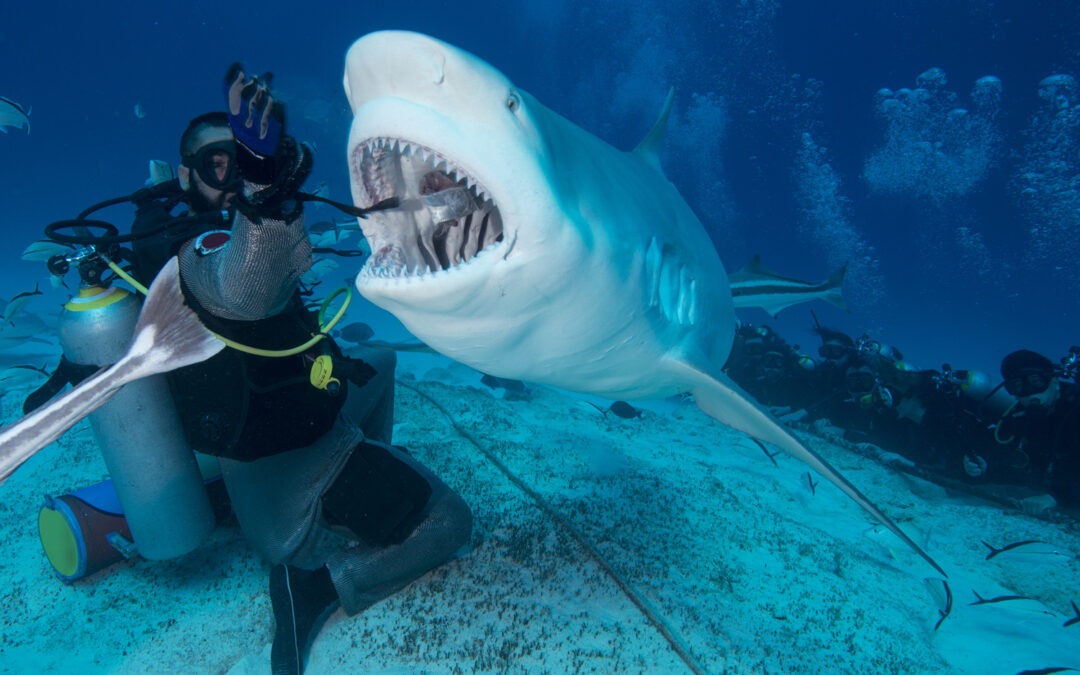
I was talking with a colleague about this amazing documentary I had watched on the Discovery Channel during their infamous “Shark Week.” I recounted to her how my mouth had been agape as this massive shark wreaked absolute havoc on the boats he met, creating shock and awe in the wake of his violence and destruction. As I excitedly described what I had seen, I noticed a slow smile beginning to spread across her face accompanied by an ever-so-slight head shake.
“What?” I asked, confused by her behavior.
“Denise, that was fake,” she said with a laugh.
“No, it wasn’t! It was on the Discovery Channel!” I insisted.
My colleague went to her keyboard and clackety-clacked a search into Google, pulling up the synopsis of the episode. Embarrassment crept up my neck into my face, and then the anger. “It was on Discovery Channel! Why would they show fictionalized shows about nature?” I raged. “Well, I’m never watching THAT channel again!”
Apparently, as I was prepping my snacks, I missed the first scene of the Shark Week show which displayed the disclaimer, “What you are about to see is fiction.” Whoops. I had watched the entire film, rapt with amazement, incredulous at how impressive sharks could be, shocked at the extreme nature of what I was seeing and bought it all – hook, line, and sinker (excuse the fishing pun).
So, why do we fall for untruths, fiction, falsities?
Biology & Neurology
Research shows that the human brain developed, like other animals, with the primary goal of survival. As such, we are highly attuned to perceived threat. This makes us sensitive to experiences and information that feel challenging and bring uncertainty, regardless of accuracy. In addition, our survival is further protected by community and connection with others. This means our sense of belonging and alignment with those around us helps us feel safe, and to stay “in” our group, we may find ourselves agreeing with statements made by the people we know and trust – again, regardless of accuracy – because the possibility of being ousted from our circle is a real threat to our survival. Finally, our brains developed to detect patterns, even where there may not be any, simply to ensure we aren’t caught unaware, and we fall prey to threats. That shadowy coil on the forest floor while hiking could be nothing, or it could be a venomous snake capable of delivering a deadly strike. Add a rattle sound to it, and we are going to react instinctively to protect ourselves. Survival requires a quick reaction, and pattern detection helps ensure that. Even if it turns out to be nothing, we live to see another day.
Experience and Memory
On the surface, it makes sense to base our beliefs on experience, but even our own experiences can’t be completely trusted. Research into human memory shows that our memories aren’t perfectly accurate. Humans have what is called “reconstructive memory” instead of reproductive memory. This means that our brains (because they are pattern seeking) fill in the gaps every time we recall something. Those gaps are informed by mental schemas (frameworks) built by emotions, prior experience, and preexisting accurate (or inaccurate) and complete (or incomplete) knowledge. Researchers believe this results in more cognitive processing efficiency (think speed) and fuels faster and more decisive decision-making.
Emotions, Assumptions, & Bias
Our desire for more of the warm and cozy feelings of belonging and certitude and less feelings of threat may also fuel confirmation bias, which is a psychological tendency to seek and retain information that confirms our existing beliefs and discount evidence that challenges our worldview. Confirmation bias goes hand in hand with motivated reasoning, which is what scientists call the very human tendency to mentally filter and manipulate information to maintain emotional and identity stability. It can be quite unnerving to be presented with information that flies in the face of what we have perhaps known for decades, and we may feel like we are drowning in confusion, betrayal, doubt, and even anger.
So, why did I fall for the Shark Week story? I believed the story because I regarded the Discovery Channel as a place for factual, scientifically backed information (pre-existing knowledge, experience, and assumption). I believed the mega-shark was possible because I am not a marine biologist, and I don’t have solid and thorough information about what is and isn’t possible when it comes to ocean creatures (lack of information). And, finally, I believed it because a large part of me is afraid of what lies deep beneath the vast ocean water. After all, it’s better to be safe than sorry, right?
Wrong.
We humans have the highest intelligence of all mammals (thanks to higher protein diets and bigger brains), and the beauty of being human is our ability to reflect on our thinking (called meta-cognition), evaluate our motivations, and choose differently. We can use our big brains to check for cognitive bias, examine evidence, and pick facts over feelings.
Although we are still products of our evolutionary ancestors and adaptations, we have the power to be more than our historical genetic programming.
Denise Fattic is a Provisionally Licensed Professional Counselor at Greenway Therapy . Learn more about her on her BIO page.